Traffic incidents and congestion mostly in urban areas represent a huge problem for modern societies since they increase greenhouse emissions and affect quality of life. Additionally, traffic incidents usually have negative effects on transportation systems and may cause delay, property and health damage, injuries, and fatalities. A traffic incident represents any unpredictable occurrence that disrupts traffic flow and reduces roadway capacity such as a broken-down vehicle, accidents and collisions. However, traffic management systems (TMS) aim to minimise the negative effects of such traffic incidents, decrease the overall travel time and fuel consumption, improve the overall traffic efficiency and enhance the safety of the transportation systems. Traffic management systems involves and utilises various tools and technologies to detect road traffic incidents (e.g. on-road sensors and cameras) before activating suitable traffic control strategies such as adjusting speed limit and diverting the traffic away from the congested areas. Traffic management systems can be categorised depending on various aspects such as the control method used (i.e. centralised, decentralised and hybrid TMS) and the applied control measure(s) (i.e. infrastructure-free and infrastructure-based TMS). Effectively, traffic management systems must operate when traffic incidents are detected and confirmed in order to minimise travel delay, maintain a reasonable level of safety for all road users and protect human life. To achieve this, the TMS can use and implement a traffic incident response plan which can involve some guidance and instructions for traffic network actors and operators in order to take action effectively and timely after traffic incidents.
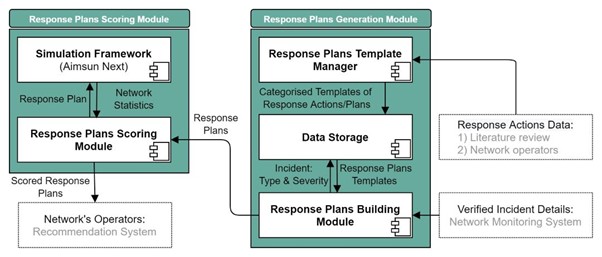
University of Wolverhampton (UoW) is a partner of FRONTIER H2020 Project which aims to develop an automated approach and integrate a tool for generating and evaluating traffic incident response plans. Therefore, response plans generator (RPG) represents one of the main FRONTIER platform services for network-wide traffic optimisation process. The RPG takes as input the traffic incidents detected in the traffic network and automatically generates many response plans RPs (each RP contains a list of response actions such as traffic diversion, speed reduction and lane closure). However, the RPG uses a predefined library of response action templates constructed according to the characteristics of the traffic network (application site such as Athens corridor) and the response logic of network operators. The real-time generation of the appropriate list of traffic incident response plans mainly depends on the type, subtype and severity of the traffic incident. Additionally, the RPG evaluates the expected impact of each response plan on the transport network performance to facilitate the decision-making of network operators in terms of which response plan to be activated and followed. This RP evaluation depends on a simulation framework (Aimsun Next software) and a network simulation model developed for the study area (i.e. Athens corridor). The implementation results show that the generated response plans can enhance and improve the overall network performance and conditions efficiently. Additionally, the RP evaluation represents a supportive tool for decision-making process of the network operators in order to select and implement the optimal response plan.